Behind the Maps: The American Revolution’s GIS Journey

While writing, Trials of War, I got the opportunity of a lifetime to work as an advisor for Florentine Films on The American Revolution. My job was to help them create nearly 100 maps that appear throughout the six-episode series. I really enjoyed that experience, and I thank PBS, Florentine Films, Ken Burns, Sarah Botstein, David Schmidt, Mike Welt, Grace Bartosh, and the many others for the chance to work with them.

My role was mostly the research behind the maps, verifying each place, region, road, path, and so on. I did that using ArcGIS, and I admit it took several thousand hours, most of which were spent before Florentine Films found me.

Once I began working with Florentine Films, I expanded the historical GIS of Colonial America I’d been developing, from the places Isaac Frye traveled during the American Revolution, to include the rest of the North American continent. During the last year or so of production, I created a web map for the graphics team at Phea.TV and the researchers at Florentine Films to check my work and verify their work. I reworked the styling of that map from the high-contrast look that made checking for errors easier to one that hopefully most people will appreciate exploring.

Click here to explore the online map of Colonial North America.

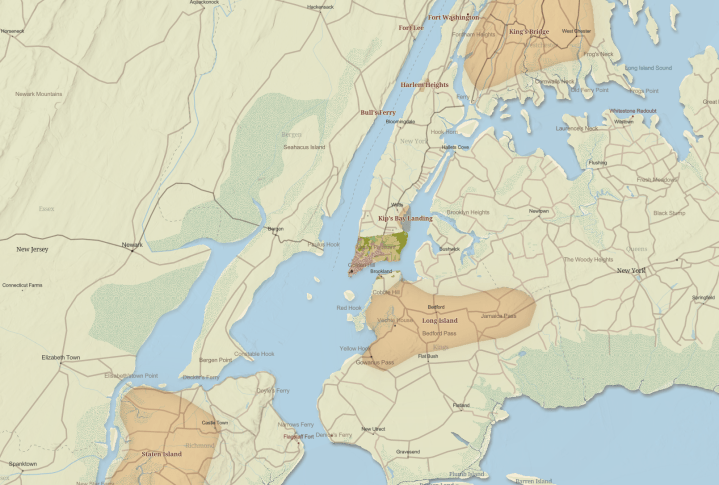
How NYC looked in Colonial North America

This excerpt shows just some of the territory that New York City occupies today.

The map includes a collection of layers that depict where the European colonists lived, but also where the North American Indian tribes lived in 1775 and 1607.

For anyone who is already an ArcGIS user, I’ve shared the web map and all of the layers in the Colonial North America Layers and Maps group in my ArcGIS Online Home Use account. The data, layers, and maps are free to use under a CC BY 4.0 SA license.

You can learn more about how we created the maps in the series by watching the LinkedIn Live stream video, The Maps Behind the American Revolution, where I, Mike Welt, and Grace Bartosh tell the story of how we made them.

-CEF

“The Trials of War” is Available

I am pleased to announce that The Trials of War is available. Normally, when I publish a new book, I share the most interesting aspects of the research in my posts. This time, my research began with family history. Abiel Frye, Isaac’s oldest brother, shows up in a surprising way. Then the challenge of unraveling how Isaac Frye came to be court-martialed late in 1779.

Ten years ago, when I first sketched out the plot for The Trials of War, I had not known Abiel would factor in. Then, a few years later, while reading Daniel Livermore’s journal entries, Abiel Frye is mentioned in the May 23, 1779 entry: “… I passed the evening very agreeably with our own corps of officers, and Mr. Abial Frye. …”

That led to some research under the auspices of, ‘What are the odds?’ First, Abiel Frye is not a common name in Colonial America. Only Isaac’s father, who died in 1757, and Isaac’s oldest brother appeared in any searches I’ve made, which include Ancestry.com and FamilySearch.org. Even with all the time afforded me during the COVID-19 shutdown, it took months to finally work out that the 3rd New Hampshire officers indeed dined with Isaac’s older brother, and I also tracked down the story of how they came to cross paths in north-central New Jersey. Here are some of the items I found:

  • This 1912 entry in the Daughters of the American Revolution’s publication, American Monthly Magazine, page 273, includes many pertinent details about Abiel Frye via a sketch of his father-in-law, Eliab Farnam’s service during the American Revolution:

“(2) Farnam (Varnum) — Fry. — Eliab Farnam is called Varnum in Miner’s History (4668), and a reference made to his regiment (p. 191). He was ensign of the first militia in Preston, Conn., Oct., 1771 ; lieutenant in same company May, 1774; and captain of the 8th Co., or train band in the 24th Conn., Oct. 11, 1775. The 24th was formed in May, 1775, and consisted of men from the town of Westmoreland, now Wilkes-Barre, and vicinity, in Pa. His second child, Joshua, was killed by the Indians in 1779 (Miner, p. 466). Abigail, dau. of Eliab Farnam, m. (1) Eleazer Owens, March 20, 1779, who was killed in the Battle of Minisink, July 2, 1779. A posthumous son, Eleazer Owens, was b. Jan. 1, 1780, and m. Margaret Buck (dau. of Elijah and Margaret (Foster) Buck). Abigail Owens, the widow, m. (2) Abiel Fry (or Frye), ensign and second lieutenant in the French and Indian Wars. He was son of Capt. Abiel, and descendant of John Fry, of Andover, Mass. He went from Andover to Pa. in 1763, and was the schoolmaster of the settlement (the Wallenpaupeck) for several years (see Miner, p. 467). Feb. 2, 1784, he m., in Goshen, Orange Co., N. Y., the widow Owens, as before stated, and lived in Goshen for ten years ; was town treasurer, a member of Solomon’s Lodge (No. 1), Poughkeepsie, Dutchess Co., N. Y (which he joined in 1775), and a member of the Presbyterian Church. In 1794, he and his wife and five children moved to Tioga Co., N. Y., but in 1806, while in Goshen on business, Abiel Fry d. of a fever. Is this service sufficient to entitle his descendants to recognition in the D. A. R.?”

That entry and question gave me my first clue, given the Frye family genealogies I’ve read indicated that Abiel Frye, had died in Goshen, NY, which is just north of the New Jersey border, only a few miles from the route taken by the troops marching from Camp Soldier’s Fortune to Easton, PA. The reference to Miner’s History of Wyoming, pages 464-476, gives more details, particularly regarding the settlement in Lackaway Township. today called Lackawana, Pennsylvania.

  • Another reference, this time in the September 1903 edition of Sons of the American Revolution’s Spirit of ’76 magazine on page 19 (link to PDF of scanned pages), provides the following:

“Two interesting articles on the early history of Masonry appeared in the October 1901, and the April 1902 issues of “The Spirit of ’76’. In neither one of those was any mention of Solomon’s Lodge, No. 1, Poughkeepsie, N.Y. The records of this lodge contain a demit to the effect that one Abiel Fry was raised to the sublime degree of Master Mason on the 14th day of June, in the year of Masonry 5775, and the year of our Lord 1775.

The above Abiel Fry or Frye was born Nov. 8, 1734, in Andover Mass.; was in the Alarm list there, April 29, 1757; at Fort William Henry Aug 10, 17 57, and continued to serve during the French and Indian wars of 1758-59 and ’60. In the year 1763 he went to the then Province of Pennsylvania. In “Miner’s History of Wyoming”, pages 466-67, reference is made of a certain schoolmaster named Fry. In all probability this is the same Abiel Fry. On the 2d of February, 1784, he married Abigail Farnum Owen (widow), in Goshen … In 1794 he with his family removed to Chemung, N.Y., and in 1793 was made an elder in the First Presbyterian Church of Chemung and Newton, now Elmira. …

Further information regarding the Above Abiel Fry or Frye, between 1763 and 1784, especially any information or proof of any service he may have rendered his country or any department, civil or military, is desired. Certain references to him in family history lead to the supposition that he may have been in the Commissary department.”

  • The latter item was attributed as a letter from Mrs. David Gillespie of Lincoln, IL.

Based on the above, I was able to fill in the gaps of Abiel’s history and fully bring him into the story.

Next, I had one rather disturbing fact to figure out. Again, this came from Daniel Livermore’s journal, this time the October 26, 1779 entry: “… and a brigade court martial is called, of which Major Titcomb is President, for the trial of Capt. Isaac Frye, of the third battalion of New-Hampshire forces of which I was a member. The charge brought against Capt. Frye was ungentlemanlike behavior and defrauding the officers of the regiment of public stores. …”

There was a lot to unpack, including the idea that Livermore may have edited his journal after the initial writing, given the clause qualifying that he was a member of the third battalion of the New Hampshire forces. Defrauding the officers, but not the enlisted soldiers, also caught my eye. Two months earlier, Livermore made a remarkable midnight journey, crossing the Great Swamp, riding fifty miles back to Easton and beyond in less than two days. He never explains the reason for his mission, but I found that it occurred the evening after a letter for Brigadier General Enoch Poor, who commanded the New Hampshire Brigade. That letter was from Major Caleb Gibbs, the commander of General Washington’s lifeguard. Gibbs mentions a quantity of liquor captured by Anthony Wayne’s forces at Stony Point. Coincidence? I doubt it. Rum and alcohol of any variety were in scarce supply. You’ll need to read the book to see how this turns out.

-CEF

Battle of Breed’s Hill Patriot Locator Map

Years ago, I decided to figure out where my ancestor, Isaac Frye, who fought in the Battle of Breed’s Hill on June 17, 1775, was positioned on that battlefield. My background as a geographer led me to map the battle using GIS and keep adding details until I succeeded.

One thing I learned is that because I located my ancestor, I could likely locate every American who likely fought, though I would need to do a few things first. These included figuring out who fought or was on the battlefield, then using GIS to place each soldier on the map at the location of their respective regiment or company.

In the spirit of keeping this post short, here is the link to the Battle of Breed’s Hill Patriot Locator Map. Use the search box to enter the surname, and if needed, the first name of any American who fought in the battle.

There are about 200 American soldiers whose names I do not know because no rolls for their companies exist any longer, or they are not in the usual repositories such as the National Archives or their respective state archives. If I’ve omitted your patriot, I would love to add them, but I will need information about their unit and some proof of their service. Contact me via a comment or an email.

CEF

The American Revolution, the new Ken Burns series

For those who have been patiently waiting for Trials of War to be released (I’m still editing and making good progress), there was a good reason this book has taken so long. I was invited to work on the American Revolution Film Project at Florentine Films, where I advised and assisted in creating nearly 100 maps that appear in the series. For the past two and a half years, I’ve thoroughly enjoyed dedicating a significant amount of my free time to contributing to the series.

For me, this involved the background research I had already been doing to produce the maps that appear in my books, and expanding it to include all of North America. I highly recommend setting aside time to watch Ken Burns’s The American Revolution, which will air and stream on PBS beginning Sunday, November 16. The six-part, 12-hour documentary series directed by Ken Burns, Sarah Botstein, and David Schmidt, explores the country’s founding struggle and its eight-year War for Independence.

I am also excited to share that I’ll be a part of @Esri’s Mapping the American Revolution Live Stream on Tuesday, November 18, 8am PT / 11am ET. If you’re interested, please use the link to register.

Finally, if you have some exposure or experience using ArcGIS, the software I use to create the maps, I invite you to explore this web map of North America in 1775. The map features the collection of GIS data I produced as the starting point for the maps in The American Revolution.

-CEF

ArcGIS Pro Map Package for Battle of Breed’s Hill

Happy 4th of July! After publishing the List of Americans in the Battle of Breed’s Hill from the Rolls last year, I had intended to also publish the ArcGIS Pro map I used as part of the research to compile the list. Today, I am finally sharing that here today.

Download: Battle of Breeds Hill Troop Locations and Movements.

The above link will open the ArcGIS Online homage page for the map package. In the upper right, click Download, and then in ArcGIS Pro, use the Import tab to add this map to your Pro project.

Included in the Map Package

  • Layers for the initial deployment of troops and artillery at the regiment and, when it was needed, at the company level.
  • Layers for locations of troops and artillery during the initial phase of the battle.
  • Layers for locations of troops and artillery during the final phase of the battle
  • Muster of the names of the Americans who fought (note this is not as current as the spreadsheet in the List of Americans in the Battle of Breed’s Hill from the Rolls.

Requirements

This map package requires using ArcGIS Pro version 2.8 or newer. ArcGIS Pro is available as Part of university site licenses or, like I use it, via the Personal Use Account.

I advise having at least an intermediate or greater level of experience/comfort using ArcGIS Pro to get full value from this map. In particular, skills to query tables within a moderately complex relational data model are needed.

Aaron Oliver and Ezra Fuller – Memorial Day

In researching my books I learn some of the details about little-known soldiers of the American Revolution who made the ultimate sacrifice. Each year when Memorial Day nears, I try to carve out time to share those stories. This year I chose two who chose to fight for American Independence from Great Britain.

I began learning about Aaron Oliver and Ezra Fuller while researching Honor and Valor because they were soldiers who enlisted in the Continental Army company my great-great-great-great-grandfather, Isaac Frye, captained. In early 1777, the regiment was recruiting and I wrote about how Isaac recruited from the towns near his home in Wilton, New Hampshire.

My habit before writing is to research the histories of the men who served in the Continental Army with Isaac Frye. Early in my research, I found the enlistment documents for Isaac Frye’s company. The first was signed by enlistees who gathered in Wilton, New Hampshire on April 1, 1777. Aaron Oliver and Ezra Fuller were present and they enlisted as private soldiers in the Continental Army for a term of three years. Their signatures are indicated in the image with red arrows.

I research genealogical information for each soldier. I found Aaron Oliver was born on 25 August 1750 in Malden, Massachusetts, and that he was married to Abigail Townsend and they had three sons, Luther, Ezra, and Aaron Jr. In 1777. They were living in Temple, New Hampshire when Aaron enlisted. Ezra Fuller was younger, born in 1757 in Lynn, MA; he was not married. He lived in Mason, New Hampshire when he enlisted.

As I continued my research, I found two unexpected references for Aaron Oliver. The first was a Daughters of the American Revolution publication, Forgotten Patriots, African American and American Indian Patriots in the Revolutionary War, A Guide to Service Sources, and Studies; and the second was Glenn A. Knoblock’s African American Historical Burial Grounds and Gravesites of New England. Forgotten Patriots provides that Oliver was of mixed heritage, “mulatto”. That got me curious and I searched for the names of all the men in Isaac Frye’s company. Ezra Fuller was included as “African American”. Knoblock provides additional history about Oliver and uses his case to illustrate the practice of “warning out”, a practice where towns ousted unwanted or burdensome people from dwelling within their boundaries.

I learned a good deal more about Oliver and Fuller from town histories and several of the muster rolls Isaac Frye and the officers of his company made each month. Several facts that applied to Oliver and Fuller have stuck with me.

  • They were born, and died, as free men.
  • Each could sign his name and therefore I presume could read and write – something three in ten of their white counterparts could or did not do.
  • The monthly muster rolls show Oliver and Fuller were not segregated within Captain Frye’s company. The rolls list the men in groups of five by their “messes”, meaning those who shared meals and tents. Frye’s rolls show messes were initially determined alphabetically. All men in the company were equals in pay, misery, risk, and soldierly duties.

Despite these inferences, I found no specific references to the character or accounts of either Oliver or Fuller in any diaries, journals, or contemporary writings. Their service was as exemplary as any other private soldier in the Continental Army.

Aaron Oliver’s Service

As the Continental Army evacuated from Fort Ticonderoga in early July of 1775, Oliver and two other men, Ensign Samuel Leeman, and Private Jonathan Foster were assigned to guard the baggage and invalids. Thus, these three were caught in the Battle of Hubbardton. Leeman was killed and Foster escaped to the east but was unable to rejoin the company until later. Knoblock provides that Oliver was taken prisoner, and taken to and held in the British prison ships at Wallabout Bay in New York. Oliver’s health deteriorated and he was released from captivity and returned home to Temple in April 1778. Isaac Frye’s muster roll for November 1778 has a notation of Oliver dying on April 30, 1778. At his death, Aaron Oliver was twenty-seven years of age. In December of 1778, Oliver’s widow, Abigail, was warned out of Temple – the town would or could not support them.

I found that fact troubling for having learned Josiah Parker’s story, and after his passing, the Town of Wilton, of similar size and means, appeared to support his widow Phebe and their children until Phebe married recently widowed John Greele a year and a half later.

It is also troubling that I have never found evidence that Aaron Oliver was ever paid or that his widow, Abigail, received any compensation for his service.

Added April 25, 2024: I happened to find one additional enlistment for Aaron Oliver in the Massachusetts Rolls (Vol. 11, p. 635): Oliver, Aaron, Temple. Descriptive list endorsed ” August 4 1775; ” Capt. Ezra Town s co., Col. James Reads regt.; rank, Private; age, 25 yrs. : stature, 5 ft. 10 in.; eyes, black; occupation, farmer; birthplace, Malden; residence, Temple; enlisted April 23. 1775; mustered July 11, 1775 ; reported a mulatto ; also reported absent on command.

Ezra Fuller’s Service

Ezra Fuller served in the place of Deacon Amos Dakin, who may also have paid his town or state bounty, a bonus for enlisting. Fuller was apparently very ill at the time Captain Frye’s company marched to Fort Ticonderoga,, as Fuller does not appear on the rolls until joining the company in September after the Battle of Freeman’s Farm. Fuller apparently fits into the company and marches with them into the Battle of Bemis Heights in which he is wounded.

Fuller spends several months recovering in Albany and is among the first to march from there to Valley Forge to join his company at some point between the muster rolls taken on April 4, 1778 and May 2, 1778. However, Fuller is immediately listed as sick. He was apparently taken to one of the hospitals in the area. Because he was not with the company and Captain Frye was also sick, but remained in the camp at Valley Forge, his disposition was unknown. He is listed on the monthly muster rolls as sick at Valley Forge through April of 1779. However, I found a record indicating he died on July 14, 1778 – he was just twenty-one or twenty-two years old. On August 28, 1782, Ezra Fuller’s father, David Fuller, was given his son’s pay.

-CEF

List of Americans in the Battle of Breed’s Hill from the Rolls

This is a roll of who was or likely was in or at the June 17, 1775 battle. It is not exact, complete, or the last word. The early historians Swett, Frothingham, Loring, et al. agreed that there is no basis for compiling an exact list. I completely agree with them, though we can compile useful from all of the available information.

Newly available in April 2026: Interactive map for locating patriot soldiers on the Breed’s Hill battlefield: Battle of Breed’s Hill Patriot Locator. This map is based on recent research aimed at revising and improving the locations of the British units.

I intend this roll as a 21st-century digital convenience. It is for those who wish to get a faster start researching patriot ancestors, town histories, etc.

Beyond appearing in each of the state rolls, there were two criteria for including soldiers in this roll:

  1. There was a “positive” statement of their being in the battle. This included being a casualty, prisoner, losing items, or being specifically listed on a roll as in the battle. There is a “Positives” column in the Company Summary tab reflecting the count of soldiers with a positive statement.
  2. The dates of service include June 17, 1775.  This is not positive proof, but proof of the potential to have taken the field. Typically, this was a roll taken between June 18 and August 2. These rolls gave enlistment dates in April, May, or June, and durations of service. There were a few rolls taken before the battle that established a term of service after accounting for those who marched and served for the April 19, 1775, alarm.  Many men who marched on April 19 went home within a week and did not return to the siege.  It is also worth noting omissions to the state rolls. There were quite a few soldiers who served from late April or early May only until the end of July and were not part of the Continental Army. There are cases where the Aug 1st Massachusetts rolls were not taken or did not survive, and I would assert as many as 250 men were not included in the state rolls or this digital version of them. There were also dozens of soldiers who fought but were from other units that are not recognized as marching. These men were on details or among friends and chose to march with their companies and regiments. There were also men who marched, took the field, and then were sent on duties, or left, and went back to camp. Such men are included as they were on the field at a time when others were in physical and mortal danger. The Company Summary tab has two fields 1B and 1A that indicate Y or N for a roll before the battle (1B) or a roll with service dates after the battle (1A).

Last, on the company summary tab, there are fields for phases and zones. Phases represent the three British offensives during the battle. Zones represent areas of relative conflict. Zone 1 is the accepted main line of battle, including the range of a musket on either side of where that line moved. Zone 2 is the rest of the Charlestown Peninsula, which required an act of bravery in and of itself to march onto via the Charlestown Neck. Zone 3 is the area beyond the Charlestown Neck including Lechmere Point. General Ward sent units to guard against a second landing of the Regulars. Col. Paul Dudley Sargent noted unfavorable winds also prevented this landing. However, these troops took casualties from cannon and grapeshot from the floating gondolas and smaller ships that could make their way deeper into the Back Bay.

If you note some one is missing or wrongly included, please email me at duty_liberty@mail.com, or comment on this blog – I generally can respond within a day or two. Follow this post to be notified of updates, which are listed below.

-CEF

Updates:

3/15/2021: Added Captains Abraham Dodge and Ezra Lunt from Col. Moses Little’s regiment.

3/14/2021: Removed most men from Capt. Abel Wilder’s company of Col. Doolittle’s Regiment – only part of the company was there. Added Capt. John Harnden’s company of Col. Bridge’s regiment. Added several individuals found due to improving the quality of the Massachusetts rolls file. Removed three duplicated soldiers.

3/10/2021: Added several from Connecticut.

3/9/2021: Added Daniel Shay

4/21/2022: Added Henry Farrington and Ichabod Farrington – previously omitted due to garbled OCR in Massachusetts rolls file.

2/29/2024: Learned of Samuel Bradish of Abel Wilder’s Company in Doolittle’s 18th Mass. Regiment. In Bradish’s record, the service dates included the battle and that he was wounded. I was surprised to see these service dates had been omitted from Capt. Wilder’s record. Based on this, I added Bradish and 44 additional soldiers from Wilder’s company. These men were predominantly from Winchendon and Royalston, with a few from Boston and Lunenberg.

Improved text for searching MA Soldiers and Sailors

The scanned text of 17 volumes of Massachusetts Soldiers and Sailors of the Revolutionary War, a Compilation from https:archive.org, was difficult to search through because there were so many errors, including misrepresented names, broken words, and garbled entire pages of text.

After several years of gradual progress, I have completed the work to correct hundreds of thousands of systematic errors in the OCR (optical character recognition) process is complete. Each record is now on one line in the file with no breaks, making it a better basis to determine the composition of companies or regiments at various times, inventory of which towns the soldiers were from, traits of soldiers from rolls that described the men (hair, eyes, height, ethnicity, occupation, etc.; and which men were in specific battles — in the form of a positive claim containing the words like killed, wounded, captured, or lost items or a tacit claim for being in the unit at the time of the battle.

The original “text view” was copied into files for each volume. I processed those files using Python to remove the arbitrary end of lines, thus concatenating the text for each soldier. My goal was to be able to do wildcard searches per soldier such that I could find matches between company commanders and regiment commanders. For instance, searching for “ilder.*Doo” would find men in Capt. Abel Wilder’s company., Col. Ephraim Doolittle’s regt. That syntax is for Notepad ++. I got tired of doing that manually in each of the 17 volumes. This also addresses not having to search across volumes for sound-alike names such as Ayres and Eyres.

This is a large file – STRONGLY RECOMMEND using in Notepad++ or do a bit of programming in Python (DO NOT ATTEMPT IN: NotePad, WordPad, or even MS Word). Both Notepad++ and Python support wildcard and extended character searching, e.g., “\n\r”. Notepad++ is limited to one wildcard, so for complex sequences, Python is the only option (using the regex library and conditional logic to mimic an SQL query with multiple WHERE clauses).

Removing end-of-line characters described above generally worked, but issues with the OCR process resulted in many false interpretations of characters and unintended insertions of new lines. So, I also started replacing some of the safer sequences:

Daxiei to Daniel x4
Daxiel to Daniel x68
Aakon to Aaron x3
Reubex to Reuben x 35
AxLEX to Allen x7
Johx to John x452
JoHx to John x63
Jamks to James x7
AVigglesworth to Wigglesworth x36
Woodbridjje to Woodbridge
Bexoxi to Benoni x5
Bexjamix to Benjamin x98
Williaji to William x70
Joxathax to Jonathan x51
Lejiuel to Lemuel x5

If you are tempted to do similar, please be aware that many seemingly safe find/replace pairs will produce unintended changes Use Find first to locate a large number of prospective changes to be certain of avoiding changing valid information.

Sometimes the OCR process in combination with a poorly printed page created a mess. For instance:

An^TT.w SPr-eant Capt. Joseph Uichards’s co.; enlisted Aug. 11, 1779; ser'”‘^”^^ZZ 3 a”;n^.’detach,nent under Capt. Samuel Fisher at Rhode Island.

Should be:

Allen, Abijah, Sergeant, Capt. Joseph Richards’s co.; enlisted Aug. 11, 1779; service 1 mo. 3 days with detachment under Capt. Samuel Fisher at Rhode Island.

Thus, if you’re looking for specific person, the scanned version on archive.org is your best option.

-CEF

Freeman’s Farm: The more I read …

For the past few weeks, I’ve been writing the scenes during the Battle of Freeman’s Farm. The perspective is from inside the 3rd New Hampshire Regiment; imagining what it was like to be in the ranks, commanding platoons and companies, and orchestrating the positioning of a regiment on that battlefield.

Most histories are written from a bird’s-eye view with the occasional tidbit coming from the diary or memoir of one of the men on the field. No complaints as those are great reads for getting introduced to the events and people involved. That said, between such histories and paintings of these battles, both new and old, something has been troubling me. How is it, given that each side had roughly 3,000 men, each man roughly twenty cartridges, and fired most of them over the 4-6 hours they were on the battlefield, that there were only a little over 1,000 total casualties?

Do that math:  The Americans fired upwards of 60,000 bullets, and maybe 1,000 found an enemy soldier. The British fired about the same number and only hit half as many Americans.

For having fired a musket and demonstrated, hundreds of times, how a firelock works, while explaining the range and just how far off target they could be at a distance of 75 yards, I was still surprised by these numbers.

As I considered the possible reasons for this, some notions of what must have been happening, strategically and tactically, began to develop.  First, the 18th-century battlefield was more like a chess match than a shooting gallery. Colonels and captains had to preserve their troops by maneuvering on the field with the dual intent of catching their enemy within range of their muskets.

Sidebar:  Is the right word musket or firelock?  If Google’s NGram Viewer is reliable, it looks like it was similar to “flip phones” versus “cell phones”. It seems that firelocks were a specific new form of the musket class of weapon. 

Smoke from firing volleys, providing the fog of battle to hide movements, was only the beginning. Advancing or retreating while firing volleys by platoon allowed for relatively high rates of sustained fire to push groups of enemy troops out of the way, or respectively slow their advance.  Getting close enough, perhaps by flanking (coming around to the side of an enemy’s formation), to warrant a bayonet charge while your enemy reloads was a tempting and dangerous goal. Execute poorly and the tables could be turned rather quickly.

Given that, my respect has risen considerably for the American Colonels (Cilley, Scammell, Cook, Adams, and Hull) who directed their men in the field around Freeman’s farm against Burgoyne and Hamilton on this day 241 years ago. These men did not just rush onto the field ala Mel Gibson (as Benjamin Martin or William Wallace) and clash with their enemy. One of the consistent recollections by the men who were there was of the tremendous amount of musketry.  That meant firing volleys, advancing, wheeling, and retreating if no advantage was gained.

Another thing to take into account was the likelihood that Morgan’s riflemen, and the Jaegers who carried rifles, accounted for a double-digit percentage of the casualties. There were points during the battle where the fighting came to hand-to-hand combat. Both of these facts imply that those muskets accounted for even fewer casualties than the 1 in 60 that my initial estimate suggested.

Consider that not all men on either side were killers. Aiming a firearm with the intent of taking a life is no small thing. Given all the smoke, there were certainly times when finding a target was impossible–just point into the smoke and pull the trigger when commanded to fire.

It seems only one man in five or even six fired a shot that struck an enemy that day. The credit for keeping the American casualties so low goes to the officers who guided their troops on the field and in the woods while they fought for something more than a sixpence.*

-CF

* From a Henry Dearborn quote: “But we who had Something more at Stake than fighting for Six Pence Pr Day kept our ground til Night, Closed the scene, & then Both Parties Retire’d”

Philip Schuyler: Crisis Manager

As I researched how Sullivan’s Brigade made its way north from Albany to Fort Ticonderoga in the late spring of 1776, I came across a remarkable document. It was a project plan sent from Major General Philip Schuyler to his commander, General George Washington describing the number of men needed, and their roles in transporting food 185 miles from Albany, NY to the Continental troops in Quebec based at Fort St. Jeans.

Schuyler learned of the need for food in a letter from Charles Carroll and Samuel Chase, two of Congress’s commissioners in Quebec, dated 11 May, 1776. They wrote, “We are unable to express our apprehensions of the distress our Army must soon be reduced to from the want of provisions, and the small-pox.”

Separately, Brigadier General John Thomas, who was now in command of the Continental Troops in Quebec wrote Brigadier General Benedict Arnold also in Quebec, on May 8, 1776 appraising him of the need of provisions in Canada:

“I shall make a stand here with a small number of men. I have but two days’ provision, and will bring them to half allowance, and remain on the ground myself till I can hear from you.”

Much of the route was over water, but to get from Albany to Fort George at the southern tip of Lake George, several overland carriages were required, including the longest at fifteen miles. The plan spelled out exactly how Schuyler would to transport barrels of pork and flour, enough for 10,000 men in about two and a half weeks.

As a mapmaker and product engineer at a software company, I learned project management is a vital skill, but I had myopically thought that skill to be a modern, i.e., 20th century competency. Schuyler’s plan shows a high level of proficiency, and his organization and efficiency of expression are also noteworthy.

Below is my transcription of Schuyler’s plan, where I have inserted additional lines to make use of right side of the page similarly to Schuyler’s original.

[1776, May 24]

An estimate of the number of men necessary to transport provisions for 10,000 men from Albany to Canada specifying the manner in which it is conveyed.

10,000 Weight of Pork is …… Barrels …  50
10,000 Weight of Flour is  ……   …….        55
add for sundries               ……..  ………….   15
To leave Albany each day ……   ………    120
At Albany the provisions is put into bateaux capable of carrying 13 Barrel when Hudson’s River has plenty of water, but henceforward only ten Barrels will be carried in each bateaux – Thus it will take 12 bateaux, but I have stationed 14 between Albany & Half moon (which are about ten miles apart) to make up for rainy days and accidents. Each of these bateaux is navigated by 3 men

…….  42 (men)

From Half Moon it is conveyed in wagons to Stillwater, the distance is 12 miles. From Stillwater it is conveyed to Saratoga (12 miles farther) in 14 boats.

…….  42 (men)

From thence it is carried two miles by land to McNeils

……  42 (men)

And four bateaux receive it there, and convey it to Fort Miller which is about 3 1/2 miles.

……  12 (men)

There is a land carriage of half a mile above the falls. Thence it is carried in 14 bateaux and the river being frigid & incommoded with rifts or small falls, each boat must have 4 men, the distance is about 8 miles.

……..   56 (men)

From Fort Edward it is carried to Fort George by land / distance 15 miles.

  Sub total  ……..  152 (men)

On Lake George, we have a flat bottom boat with sails, which will carry about 200 barrels and allowing five days for a trip, she carries at a rate of 40 barrels a day & is navigated by 11 batteaus carrying 30 barrels each & navigated by seven men,

…….  8 (men)

working a trip in four days – convey at the rate of about 82 barrels the length of the lake 36 miles.

…… 77 (men)

From the North end of Lake George it is conveyed 1 1/2 miles by land to Lake Champlain, where it is put in one bateaux making 4 trips a day and carried to Ticonderoga, the distance about 1 1/2 miles.

……. 7  (men)

On Lake Champlain we have two schooners, a sloop, and Row Galley which may carry about 600 barrels and make a voyage to St. John’s (about 120 miles in ten days, which is at the rate of 60 barrels a day navigated by sailors assisted by about

…… 30 (men)

For the remaining sixty barrels per day it will take 20 bateaux carrying 30 barrels each making a voyage in 10 days navigated by 8 men each.

……  160 (men)

total ……. 434

Allow for sick, lame, & lazy …… 66

Total of  ….. 500

A guard at Half Moon of privates: 12
A guard at Stillwater of privates: 12
A guard at Saratoga of privates: 24
A guard at McNeils of privates: 12
A guard at Fort Miller of privates: 12
A guard at Fort Edward of privates: 12

560

At the landing at the north end of Lake George and at the North side of the carrying place:

48
At crown Point: 24
Fort George should not by any means have a garrison of less than 200
Ticonderoga should have a like number: 200

Total 1,060

For opening Wood Creek & repairing Roads: 232

Total: 1,300

Colo. Van Schaick’s Regiment by last: 425
Colo. Wynkoop’s Regiment supposed at last: 300
Hired Bateauxmen: 100
Total: 825

If no flour is to be sent it will reduce the number of men to be employed in bateaux to about 250… If therefore about 250 men were sent to the six posts it would suffice.

The scans of Schuyler’s plan are available online at the Library of Congress’s collection of George Washington’s papers.

Another reason this plan is noteworthy is that it was not previously transcribed like much of the collection, and thus, not text searchable, so unless you are specifically searching for this, you would be unlikely to find it. I happened to be searching for all correspondence between generals Schuyler, Sullivan, and Arnold during May of 1776, trying to determine their whereabouts and the location of Sullivan’s troops as they moved north from Albany.

In The War has Begun, I wrote of how Quartermaster Isaac Frye and the 3rd NH Regiment played a role in implementing this plan as they moved north from Albany in May of 1776 to support the Continental troops already in Quebec.

Citations:

George Washington Papers, Series 4, General Correspondence: Philip J. Schuyler to George Washington, May 24, 1776, with Estimate of Men. 1776. Manuscript/Mixed Material. Retrieved from the Library of Congress, <https://www.loc.gov/item/mgw444852/>.

Force, Peter, 1837, American Archives: Fourth Series Containing a Documentary History of the English Colonies in North America, from the King’s message to Parliament, of Mar 7, 1774 to the Declaration of Independence by the United States.  Series 4, Volume 6. M. St. Clair Clark and Peter Force Under Authority of an Act of Congress, Passed on the Second of March, 1833. Washington D.C. p. 482 (letters from commissioners and General Thomas)

George Washington Papers, Series 4, General Correspondence: Charles Carroll and Samuel Chase to Philip J. Schuyler, May 16, 1776. 1776. Manuscript/Mixed Material. Retrieved from the Library of Congress, <https://www.loc.gov/item/mgw444803/>.

-CEF