“The Trials of War” is Available

I am pleased to announce that The Trials of War is available. Normally, when I publish a new book, I share the most interesting aspects of the research in my posts. This time, my research began with family history. Abiel Frye, Isaac’s oldest brother, shows up in a surprising way. Then the challenge of unraveling how Isaac Frye came to be court-martialed late in 1779.

Ten years ago, when I first sketched out the plot for The Trials of War, I had not known Abiel would factor in. Then, a few years later, while reading Daniel Livermore’s journal entries, Abiel Frye is mentioned in the May 23, 1779 entry: “… I passed the evening very agreeably with our own corps of officers, and Mr. Abial Frye. …”

That led to some research under the auspices of, ‘What are the odds?’ First, Abiel Frye is not a common name in Colonial America. Only Isaac’s father, who died in 1757, and Isaac’s oldest brother appeared in any searches I’ve made, which include Ancestry.com and FamilySearch.org. Even with all the time afforded me during the COVID-19 shutdown, it took months to finally work out that the 3rd New Hampshire officers indeed dined with Isaac’s older brother, and I also tracked down the story of how they came to cross paths in north-central New Jersey. Here are some of the items I found:

  • This 1912 entry in the Daughters of the American Revolution’s publication, American Monthly Magazine, page 273, includes many pertinent details about Abiel Frye via a sketch of his father-in-law, Eliab Farnam’s service during the American Revolution:

“(2) Farnam (Varnum) — Fry. — Eliab Farnam is called Varnum in Miner’s History (4668), and a reference made to his regiment (p. 191). He was ensign of the first militia in Preston, Conn., Oct., 1771 ; lieutenant in same company May, 1774; and captain of the 8th Co., or train band in the 24th Conn., Oct. 11, 1775. The 24th was formed in May, 1775, and consisted of men from the town of Westmoreland, now Wilkes-Barre, and vicinity, in Pa. His second child, Joshua, was killed by the Indians in 1779 (Miner, p. 466). Abigail, dau. of Eliab Farnam, m. (1) Eleazer Owens, March 20, 1779, who was killed in the Battle of Minisink, July 2, 1779. A posthumous son, Eleazer Owens, was b. Jan. 1, 1780, and m. Margaret Buck (dau. of Elijah and Margaret (Foster) Buck). Abigail Owens, the widow, m. (2) Abiel Fry (or Frye), ensign and second lieutenant in the French and Indian Wars. He was son of Capt. Abiel, and descendant of John Fry, of Andover, Mass. He went from Andover to Pa. in 1763, and was the schoolmaster of the settlement (the Wallenpaupeck) for several years (see Miner, p. 467). Feb. 2, 1784, he m., in Goshen, Orange Co., N. Y., the widow Owens, as before stated, and lived in Goshen for ten years ; was town treasurer, a member of Solomon’s Lodge (No. 1), Poughkeepsie, Dutchess Co., N. Y (which he joined in 1775), and a member of the Presbyterian Church. In 1794, he and his wife and five children moved to Tioga Co., N. Y., but in 1806, while in Goshen on business, Abiel Fry d. of a fever. Is this service sufficient to entitle his descendants to recognition in the D. A. R.?”

That entry and question gave me my first clue, given the Frye family genealogies I’ve read indicated that Abiel Frye, had died in Goshen, NY, which is just north of the New Jersey border, only a few miles from the route taken by the troops marching from Camp Soldier’s Fortune to Easton, PA. The reference to Miner’s History of Wyoming, pages 464-476, gives more details, particularly regarding the settlement in Lackaway Township. today called Lackawana, Pennsylvania.

  • Another reference, this time in the September 1903 edition of Sons of the American Revolution’s Spirit of ’76 magazine on page 19 (link to PDF of scanned pages), provides the following:

“Two interesting articles on the early history of Masonry appeared in the October 1901, and the April 1902 issues of “The Spirit of ’76’. In neither one of those was any mention of Solomon’s Lodge, No. 1, Poughkeepsie, N.Y. The records of this lodge contain a demit to the effect that one Abiel Fry was raised to the sublime degree of Master Mason on the 14th day of June, in the year of Masonry 5775, and the year of our Lord 1775.

The above Abiel Fry or Frye was born Nov. 8, 1734, in Andover Mass.; was in the Alarm list there, April 29, 1757; at Fort William Henry Aug 10, 17 57, and continued to serve during the French and Indian wars of 1758-59 and ’60. In the year 1763 he went to the then Province of Pennsylvania. In “Miner’s History of Wyoming”, pages 466-67, reference is made of a certain schoolmaster named Fry. In all probability this is the same Abiel Fry. On the 2d of February, 1784, he married Abigail Farnum Owen (widow), in Goshen … In 1794 he with his family removed to Chemung, N.Y., and in 1793 was made an elder in the First Presbyterian Church of Chemung and Newton, now Elmira. …

Further information regarding the Above Abiel Fry or Frye, between 1763 and 1784, especially any information or proof of any service he may have rendered his country or any department, civil or military, is desired. Certain references to him in family history lead to the supposition that he may have been in the Commissary department.”

  • The latter item was attributed as a letter from Mrs. David Gillespie of Lincoln, IL.

Based on the above, I was able to fill in the gaps of Abiel’s history and fully bring him into the story.

Next, I had one rather disturbing fact to figure out. Again, this came from Daniel Livermore’s journal, this time the October 26, 1779 entry: “… and a brigade court martial is called, of which Major Titcomb is President, for the trial of Capt. Isaac Frye, of the third battalion of New-Hampshire forces of which I was a member. The charge brought against Capt. Frye was ungentlemanlike behavior and defrauding the officers of the regiment of public stores. …”

There was a lot to unpack, including the idea that Livermore may have edited his journal after the initial writing, given the clause qualifying that he was a member of the third battalion of the New Hampshire forces. Defrauding the officers, but not the enlisted soldiers, also caught my eye. Two months earlier, Livermore made a remarkable midnight journey, crossing the Great Swamp, riding fifty miles back to Easton and beyond in less than two days. He never explains the reason for his mission, but I found that it occurred the evening after a letter for Brigadier General Enoch Poor, who commanded the New Hampshire Brigade. That letter was from Major Caleb Gibbs, the commander of General Washington’s lifeguard. Gibbs mentions a quantity of liquor captured by Anthony Wayne’s forces at Stony Point. Coincidence? I doubt it. Rum and alcohol of any variety were in scarce supply. You’ll need to read the book to see how this turns out.

-CEF
Balancing the Balance of Power

On May 5, 1776, General George Washington wrote to Congress. Among the many items was this paragraph:

“I beg leave to lay before Congress, a Copy of the proceedings of a Court Martial upon Lieutenant Grover of the 2d. Regiment, and of his defence, which I should not have troubled them with, had I not conceived the Courts Sentence upon the facts stated in the proceedings, of a singular nature; the small fine imposed, by no means adequate to the enormity of his offence and to be a dangerous and pernicious tendency: for these reasons, I thought it my duty to lay the proceedings before them, in order to their forming such a Judgment upon the Facts, as they shall conceive right and just, and advancive of the Public Good. At the same time I would mention, that I think it of material consequence that Congress should make a resolve, taking away the supposed right of succession in the Military line from one Rank to another, which is claimed by many upon the happening of vacancies, and upon which principle this Offence seems to have originated in a great measure, and this extraordinary Judgement to be founded; declaring that no succession or promotion can take place in case of vacancies, without a Continental Commission giving and Authorizing it.”

In Congress on May 10, 1776 it was resolved:

“That this Congress has hitherto exercised, and ought to retain the power of promoting the officers in the continental service according to their merit; and that no promotion or succession shall take place upon any vacancy, without the authority of a continental Commission.”

Thus, not even his Excellency, General George Washington, would not have the power to promote an officer in the Army he commanded.  An act of Congress would be required. Even in the early days of the American Revolution, the idea of a balance of power was in practice. Washington also knew who held the power over his own commission, and personally, in later correspondence with Congress made recommendations for many of the officers, in addition to forwarding the recommendations from the thirteen provincial congresses that recommended which officers should be commissioned.

These commissions, however, did not arrive immediately. In Isaac Frye’s case, New Hampshire made the recommendation in March 1777, but the commission was not signed until June 1779, more than two years afterward.

Sources:

George Washington Papers, Series 4, General Correspondence: George Washington to Continental Congress, May 5. May 5, 1777. Manuscript/Mixed Material. https://www.loc.gov/item/mgw447183/.

Livermore, Abiel Abbot and Putnam, Sewall 1888. “History of the Town of Wilton, Hillsborough County, New Hampshire with a Genealogical Register” Marden & Rowell, Printers, Lowell, MA. Page 106 has a transcription of Isaac Frye’s commission to rank as Captain, which was signed by John Jay, President of Congress, on June 16, 1779.

Charlestown Ablaze

Charlestown In Flames
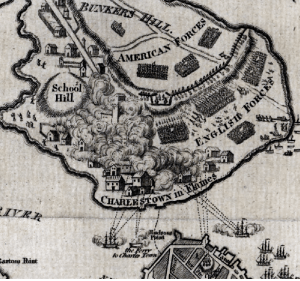
Robson Map: Depicts the Battle of Breeds Hill, where Charlestown was burned by the British.

242 years ago on June 17, 1775, Charlestown was set ablaze to drive out three companies of American militia. At the outset of the Battle of Breeds Hill, these militiamen had taken positions on the north side the town. As the ranks of redcoats marched up the slope of Breeds Hill to Warren’s Redoubt the militiamen and fired into their ranks, likely taking a hundred or more out of the battle before the main action got started.

Imagine you are in the militia with these men. It is a sweltering afternoon with the sun high overhead. The British gunships on the other side of town in the Charles River and the battery at Copps Hill in Boston blast a screaming leaden hail of fiery-hot grapeshot at the mostly wooden buildings you have been using for cover and concealment. The gun-smoke blowing on the wind is, by degrees, pushed out by wood-smoke as the temperature in Charlestown rises.

My ancestor, Isaac Frye, was one of these militiamen, serving as a 2nd lieutenant and quartermaster for Colonel James Reed’s 3rd New Hampshire Regiment. During the battle Isaac Frye was assigned to Captain Josiah Crosby’s company along with a number of the men from his hometown of Wilton, New Hampshire.

In The War has Begun, Chapter 5 describes what I imagined it would have been like to be there, marching into Charlestown, taking up positions, and firing on redcoats who were marching by–easy targets, far too easy. It must have weighed on those men’s souls to shoot an enemy who was not facing them. The inferno driving them from Charlestown, to some, must have seemed as if gates of hell had been thrown open.

Burning of Charlestown
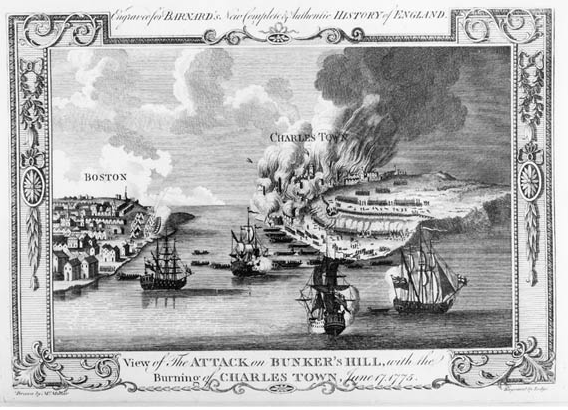
Alexander Hogg: View of the Attack on Bunker Hill with the Burning of Charlestown, June 17, 1775

If the illustrations and engravings depicting Charlestown’s fate are true, the flames from the resulting conflagration towered a hundred feet, and the smoke could be seen for dozens of miles.

It took three years to definitively locate Isaac Frye during the battle. The idea was that I could help my oldest son with his 5th grade history project. We decided to figure out where Isaac Frye was during the Battle of Breeds Hill. In the two weeks he had to finish his project, we learned Isaac Frye was in Reed’s regiment, and therefore he was either at the rail fence or there was a chance of him being with Crosby’s company in Charlestown.

About two years later I discovered New Hampshire’s Rolls of the Soldiers in the Revolutionary War, where I learned the composition of Crosby’s company, which included men from Wilton.  The final proof came a year later when I learned there were additional volumes in New Hampshire’s state papers pertaining to the Revolutionary War.  There, I found a record for the men of Crosby’s company who had lost clothing and other articles in Charlestown, and the list included Isaac Frye, who lost a coat and hat.

-CEF

Sources:

Bouton, Nathaniel D.D. 1878. “Provincial Papers. Documents and Records Relating to the Province of New-Hampshire, From 1764 to 1776; Including the whole Administration of Gov. John Wentworth; the Events immediately preceding the Revolutionary War; the Losses at the Battle of Bunker Hill, and the Record of all Proceedings till the end of our Provincial History.” Volume VII. Orren C. Moore, State Printer. Nashua, NH. p 596.

Frothingham, Richard, 1873, “History of the Siege of Boston, and of the Battles of Lexington, Concord, and Bunker Hill. Also, an Account of the Bunker Hill Monument. With Illustrative Documents.” Fourth Edition, Little, Brown, and Company, Boston, MA. p136: Lists Crosby’s company as being in Charlestown.

Hammond, Isaac, W. 1885. “Rolls of the Soldiers in the Revolutionary War 1775, to May, 1777 with an appendix, embracing diaries of Lieut. Jonathan Burton ” Volume I of War Rolls. Volume XIV of the Series. Parsons B. Cogswell, State Printer, Concord, NH

Hogg, Alexander 1783 “View of the Attack on Bunker’s Hill with the Burning of Charlestown.” Engraving after Millar. In Edward Bernard, The New, Comprehensive and Complete History of England. London

Page, Thomas Hyde 1775 “A plan of the action at Bunkers-Hill, on the 17th. of June, 1775, between His Majesty’s troops under the command of Major General Howe, and the rebel forces,”

Robson, T. 1778 “Plan of the town with the attack on Bunkers-Hill in the peninsula of Charlestown, the 17th. of June 1775. Newcastle upon Tyne [Eng.].

New Letters Uncovered

In The War has Begun, I include transcripts from the two letters my family has preserved. One is from Isaac to his wife, Elizabeth, in 1775, and the other from Elizabeth late in 1776. I spent hours thinking about the story between the lines of these letters, and am grateful my cousin found these in the attic of Isaac’s house in the 1990s.

Fast forward to this past Monday evening. I was having dinner in North Hampton with my uncle and cousin, celebrating getting the book published. My uncle asked to get scans of the two letters so he could share with others in the family. Last night we learned the steamer trunk where our two letters were found also contained five more documents wrapped within non-descript paper!

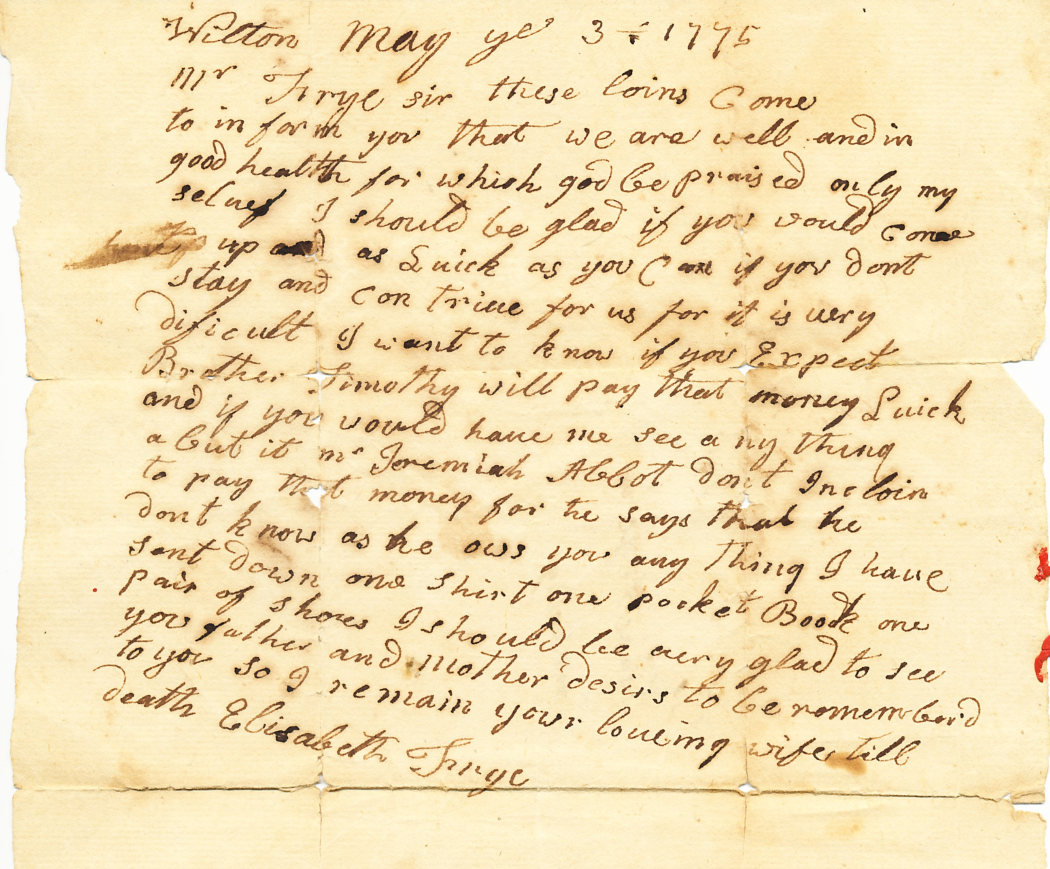
May 3 1775 letter from Elizabeth Frye to Isaac Frye
Elizabeth Frye writes to her husband, Isaac Frye is quartermaster of one of the New Hampshire militia regiments of minutemen who responded to the alarm raised on April 19, 1775.

The above letter is one of the five documents. How cool is that? This letter was written two weeks after the alarm, and confirms the militia were being supplied by their families and towns during the early days of the Siege of Boston. The part about whether Isaac owed money to Jeremiah Abbot illustrates the difficulty the wives, who were forced into the role of agent for their husbands. Note: there were no banks in these days–IOUs served as contracts between neighbors. 

Enjoy

-CEF