This is a roll of who was or likely was in or at the June 17, 1775 battle. It is not exact, complete, or the last word. The early historians Swett, Frothingham, Loring, et al. agreed that there is no basis for compiling an exact list. I completely agree with them, though we can compile useful from all of the available information.
Newly available in April 2026: Interactive map for locating patriot soldiers on the Breed’s Hill battlefield: Battle of Breed’s Hill Patriot Locator. This map is based on recent research aimed at revising and improving the locations of the British units.
I intend this roll as a 21st-century digital convenience. It is for those who wish to get a faster start researching patriot ancestors, town histories, etc.
Beyond appearing in each of the state rolls, there were two criteria for including soldiers in this roll:
- There was a “positive” statement of their being in the battle. This included being a casualty, prisoner, losing items, or being specifically listed on a roll as in the battle. There is a “Positives” column in the Company Summary tab reflecting the count of soldiers with a positive statement.
- The dates of service include June 17, 1775. This is not positive proof, but proof of the potential to have taken the field. Typically, this was a roll taken between June 18 and August 2. These rolls gave enlistment dates in April, May, or June, and durations of service. There were a few rolls taken before the battle that established a term of service after accounting for those who marched and served for the April 19, 1775, alarm. Many men who marched on April 19 went home within a week and did not return to the siege. It is also worth noting omissions to the state rolls. There were quite a few soldiers who served from late April or early May only until the end of July and were not part of the Continental Army. There are cases where the Aug 1st Massachusetts rolls were not taken or did not survive, and I would assert as many as 250 men were not included in the state rolls or this digital version of them. There were also dozens of soldiers who fought but were from other units that are not recognized as marching. These men were on details or among friends and chose to march with their companies and regiments. There were also men who marched, took the field, and then were sent on duties, or left, and went back to camp. Such men are included as they were on the field at a time when others were in physical and mortal danger. The Company Summary tab has two fields 1B and 1A that indicate Y or N for a roll before the battle (1B) or a roll with service dates after the battle (1A).
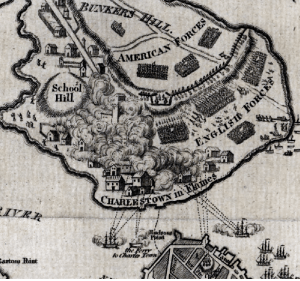
Last, on the company summary tab, there are fields for phases and zones. Phases represent the three British offensives during the battle. Zones represent areas of relative conflict. Zone 1 is the accepted main line of battle, including the range of a musket on either side of where that line moved. Zone 2 is the rest of the Charlestown Peninsula, which required an act of bravery in and of itself to march onto via the Charlestown Neck. Zone 3 is the area beyond the Charlestown Neck including Lechmere Point. General Ward sent units to guard against a second landing of the Regulars. Col. Paul Dudley Sargent noted unfavorable winds also prevented this landing. However, these troops took casualties from cannon and grapeshot from the floating gondolas and smaller ships that could make their way deeper into the Back Bay.
If you note some one is missing or wrongly included, please email me at duty_liberty@mail.com, or comment on this blog – I generally can respond within a day or two. Follow this post to be notified of updates, which are listed below.
-CEF
Updates:
3/15/2021: Added Captains Abraham Dodge and Ezra Lunt from Col. Moses Little’s regiment.
3/14/2021: Removed most men from Capt. Abel Wilder’s company of Col. Doolittle’s Regiment – only part of the company was there. Added Capt. John Harnden’s company of Col. Bridge’s regiment. Added several individuals found due to improving the quality of the Massachusetts rolls file. Removed three duplicated soldiers.
3/10/2021: Added several from Connecticut.
3/9/2021: Added Daniel Shay
4/21/2022: Added Henry Farrington and Ichabod Farrington – previously omitted due to garbled OCR in Massachusetts rolls file.
2/29/2024: Learned of Samuel Bradish of Abel Wilder’s Company in Doolittle’s 18th Mass. Regiment. In Bradish’s record, the service dates included the battle and that he was wounded. I was surprised to see these service dates had been omitted from Capt. Wilder’s record. Based on this, I added Bradish and 44 additional soldiers from Wilder’s company. These men were predominantly from Winchendon and Royalston, with a few from Boston and Lunenberg.