As I’ve been writing “Honor and Valor”, book two of Duty in the Cause of Liberty, I have had to get back into research mode. I always look for journals written by the men who were there–these journals have an authenticity historians cannot replicate. In writing about the lead-up to the evacuation of Fort Ticonderoga, I found a reference to the “Diary of Lieut. Nathan Weare Kept at Ticonderoga and During the Retreat, 1777.” Read more
Wilton Meetinghouse Tragedy

Wilton Meetinghouse and surrounding town today. The festive raising of the Wilton meetinghouse turned to tragedy in 1773 when a worm-eaten support post gave way. All 53 of the men working on the roof beams fell 27 feet among axes, planks, hammers and crowbars. The Essex Gazette of Salem called it ‘the most melancholy Accident…that perhaps […]
via The Wilton Meetinghouse Collapse of 1773 — New England Historical Society
There is also an excellent book on this topic, The Meetinghouse Tragedy by Charles E. Clark, with Illustrations by John Hatch. It gets into the details–worth a read; I have a copy, and learned Isaac Frye was one of the men who was injured.
-CEF
On the James McGregore Affair
First, it is good to be back to writing after a very busy few weeks at work. While I was away, I realized the calendars from The War has Begun and the current year have aligned, so I have made it my goal to keep this blog in step with the book’s calendar. Thus, Chapter 6, A Lesson in Patience, which featured an unexpected addition to the 3rd Regiment’s staff, in the person of James McGregore. McGregore arrived in the American Army’s camp shortly after the Battle of Breed’s Hill, and shortly thereafter obtained a letter from the provincial congress appointing him as the adjutant of Colonel James Reed’s 3rd NH Regiment. Read more
On the Elusive History of Brigadier General James Reed
I use the term “elusive” because I had questions about James Reed’s service in Quebec (May and June of 1776) that I was unable to answer as I wrote about him in The War has Begun. The biographical sketches I found only agreed agreed on one fact: that he was rendered blind due to a “malignant” illness he acquired at Crown Point in early July of 1776, during the Continental Army’s retreat from Quebec.
One account, provided by Amos Blake in 1888, indicates Reed negotiated with Native Americans in the absence of Benedict Arnold, which would presumably have been in Quebec as that was the only time Reed and Arnold were in close proximity. I could find no evidence to support this claim. Blake mentions a letter to Congress, which may no longer exist. I searched through the Library of Congress’s holdings and the New Hampshire Provincial Congress’s records and found nothing from Reed.
Add to this, the fact that Arnold was in command of Montreal, where I am now certain Reed did not go (though his regiment did). However, Arnold did negotiate with Native Americans prior to Reed’s arrival in Quebec.
With regard to Amos Blake, he was a resident of Fitzwilliam, NH, the town Reed marched from in response to the alarm of April 19, 1775. Blake was a state senator, and apparently had an interest in history and Fitzwilliam’s most famous Revolutionary War soldier, James Reed.
For context, I should include that James Reed’s character is consistently referred to in the highest regard. Thus, I am merely at a loss for details of his service from late May to July of 1776, when his 3rd New Hampshire Regiment was assigned to the Northern Department, which meant being sent under Brigadier General John Sullivan to support the army already in Quebec.
Between Dr. Lewis Beebe’s journal and correspondence between Sullivan and Arnold (in George Washington’s papers at the Library of Congress), I was able to establish where Reed was, and the following list is what I do feel confident about:
- June 3, 1776: Journal of Dr. Lewis Beebe notes that Sullivan’s Brigade, which includes Reed’s Regiment marched for Fort St. Johns to Fort Chambly.
- June 5, Dr. Beebe’s journal entry, tells of Colonel Reed having small pox very lightly. Noting Beebe was at St. Johns, and he described Reed as being on the other side of the river, establishing he was not at Chambly with his regiment. Note that Reed’s second in command, LTC Israel Gilman, had gone ahead of the regiment and was already at Chambly on May 30th to participate in a council of war.
- June 8, General Sullivan writes to General Washington, where he includes that Reed’s Regiment only had forty fit men (owing to sickness). [I suspect this was exaggerated]
- June 12, Alexander’s Scammell’s report on the troops in Canada (in Washington’s papers) shows about two thirds of Reed’s regiment is at Montreal. Note that Scammell prepared the report while in Montreal, and therefore had first-hand knowledge.
- June 12, Dr. Beebe’s journal entry: “By invitation crossed the river and dined with
Colo. Reed, Mr. Barnum & a number of other Gent’n Had a most elegant table in the wilderness. It is pleasant and agreeable in this Strange land, now and then to see old friends, and be a little sociable in retirement.” This places Reed at St. Johns, and not in Montreal. This also implies Reed was not terribly afflicted with the Small Pox. [Also, in reading Beebe’s journal, I note he was not given to sarcasm or overstatement] - June 13, Reed’s Regiment is noted as being at Montreal by the account in the 2nd New Jersey regiment’s orderly book.
- June 13, Benedict Arnold writes from Chambly, to General Sullivan. Arnold indicates he was in St. Johns on the 12th, and notes the place was in “the greatest confusion”. No mention of negotiations with native Americans.
Given the above, Blake’s claim seems unlikely. One bit of good fortune, however, was while researching this blog, I found the transcript of James Garfield’s 1899 talk on James Reed, which contained a great deal of information about Reed’s service during the Seven Years War. However, his time in Quebec was summed up with this rather generic statement, “Col. Reed was active and efficient in conducting the retreat from that point to Ticonderoga, where they arrived on the first of July.”
Last, if you know of the source Blake used, or have additional information about General James Reed’s time in Quebec, please leave a comment telling me about it.
-CEF
Sources:
Beebe, Lewis, 1935 “Journal of a Physician on the Expedition Against Canada in 1776” The Pennsylvania Magazine Vol LIX, Number Four.
Blake, Amos J. 1888. “GEN. JAMES REED. Sketch of his Life and Character”, Proceedings of the New Hampshire Historical Society. Vol. 1 Part 4 1884-1888. pp. 109-115. P113: On one occasion, in the absence of Arnold, he received and held a talk with the chiefs of some Indian tribes. It was managed with address, and successfully concluded by Colonel Reed ; and the pledges of their friendly disposition were transmitted by him to the president of congress. No record of this is indicated in either the Continental Congress or the New Hampshire Congress.
Fitzpatrick, John C. “The Writings of George Washington from the Original Manuscript Sources, 1745-1799” in “The George Washington Papers at the Library of Congress, 1741-1799” accessed throughout 2015 and 2016. Scammell’s report and Sullivan’s & Arnold’s correspondence are in this collection.
Garfield, James F.D. 1899 (read) 1908 (published) “General James Reed” Proceedings of the Fitchburg Historical Society and Papers Relating to the History of the Town read by some members. Vol IV pp. 113-124.
Salsig, Doyen. 1980. “Parole: Quebec; Countersign: Ticonderoga; Second New Jersey Regimental Orderly Book 1776” Fairleigh Dickinson University Press, Toronto
Mapping the Path Taken 240 Years Ago
When I started researching Isaac Frye, I had the easy-to-say idea of tracing his path on a map as he made his way through the American Revolution.
So, how can you really know where someone walked, slept, or rode two hundred and forty years ago? Read more
Patriots in The War has Begun
Though The War has Begun is a work of fiction, the people and events were real. Part of my work for the book included genealogical research to learn the age and sufficient history of each person. For members of SAR and DAR, I thought a list of patriot ancestors who appear in the book would be of interest.
Main Characters:
Isaac Frye (b. Feb 6, 1748, Andover, MA)
Elizabeth (Holt) Frye (b. Nov 25, 1749, Andover, MA)
Lieutenant Stephen Peabody (b. Sep 3, 1742, Hampton, NH)
Colonel James Reed (b. Jan 8, 1722, Woburn, MA)
Lieutenant Colonel Israel Gilman (b 1729, Exeter, NH)
Lieutenant James Otis (b 1751, Montville, Connecticut)
Minor Characters:
Nahum Baldwin (b. May 3, 1734, Sudbury, MA)
James Blanchard (b. Sep 20, 1742, Dunstable NH)
James Brown (b. Oct 28, 1723, Boston, MA)
Will Burton (b. 1764, Wilton, NH)
Lieutenant Butterfield (???)
Josiah Crosby (b. Nov 24, 1730, Billerica, MA)
James Frye (b. 1709, Andover, MA)
William Goforth (b. Apr 1, 1731, Philadelphia, PA)
James Gray (b. Oct 8, 1749, Newburyport, MA)
John Greele (b. Apr 26, 1759, ?)
Jonathan Greele (b. Apr 24, 1756, ?)
Nathaniel Greele (b. Oct 28, 1744, Hudson, NH)
Thomas Grover (b. Mar 19, 1738, Grafton, MA )
Nathan Hale (b. Sep 23,1743, Hampstead, NH)
Thomas Hartley (Sep 7, 1748, Colebrookdale, PA)
William Adrian Hawkins (b Jan 18, 1742, Bordeaux, France)
Jacob Hind (b. Jan 22, 1730, Shrewsbury, MA)
Elizabeth (Holt) Holt ( b.Jun 1718, Andover, MA)
Hannah (Holt) Whitney (b. Jan 18, 1754, Andover, MA)
Sarah (Holt) Pierce (b. May 31, 1757, Andover, MA)
Timothy Holt Sr ( b.Jan 17, 1721, Andover, MA)
Timothy Holt Jr. (b. May 19, 1746, Andover, MA)
Archelaus Kenney (b. Mar 14, 1758, Middleton, MA)
David Kenney (b. 18 Sep 1760, Middleton, MA)
Ebenezer Kingsbury (?)
Rev. Jonathan Livermore (b. Dec 7, 1729, Westborough, MA)
Samuel Osgood (b. Feb 3, 1747, North Andover, MA 1st Postmaster General of U.S)
Phebe (Greeley?) Parker (b. 1743, ?)
Henry Parker (b. 1705, Dunstable, MA)
Sarah (Farwell) Parker (b. Dec 4, 1706, Dunstable, MA)
Jonas Perry (b. 1747, Lexington, MA)
Samuel Pettingill (b. Mar 16, 1731, Andover, MA)
Sarah (Taylor) Rideout (b. Nov 20, 1748, Wilton?)
Paul Dudley Sargent (b. 1745, Salem, MA)
Nathaniel Sawyer (b. Jul 10, 1750, Dracut, MA)
James Sawyer (b. 1745, Woburn, MA)
Alexander Scammell (b. May 16, 1742, Milford, MA)
Phillip Schuyler (b. Nov 20, 1733, Albany NY)
Levi Spaulding (b. Oct 23, 1737, Hudson, NH)
John Stark (b Aug 28, 1728, Londonderry, NH)
John Stephens (b 1731, ?)
Ephraim Stone (b. Jan 22, 1745, Harvard, MA)
Ezra Towne (b. Apr 30, 1736, Topsfield, MA)
John Trumbull (b. Jun 6, 1756, Lebanon, CT Artist, who painted “The Declaration of Independence” and other well-known paintings of the American Revolution)
Nathan Whiting (b. Apr 6, 1750, Pelham, NH)
Richard Whitney (b. Apr 22, 1743, Oxford, MA)
Isaac Wyman (b. Jan 18, 1724, Woburn, MA)
-CEF
New Letters Uncovered
In The War has Begun, I include transcripts from the two letters my family has preserved. One is from Isaac to his wife, Elizabeth, in 1775, and the other from Elizabeth late in 1776. I spent hours thinking about the story between the lines of these letters, and am grateful my cousin found these in the attic of Isaac’s house in the 1990s.
Fast forward to this past Monday evening. I was having dinner in North Hampton with my uncle and cousin, celebrating getting the book published. My uncle asked to get scans of the two letters so he could share with others in the family. Last night we learned the steamer trunk where our two letters were found also contained five more documents wrapped within non-descript paper!
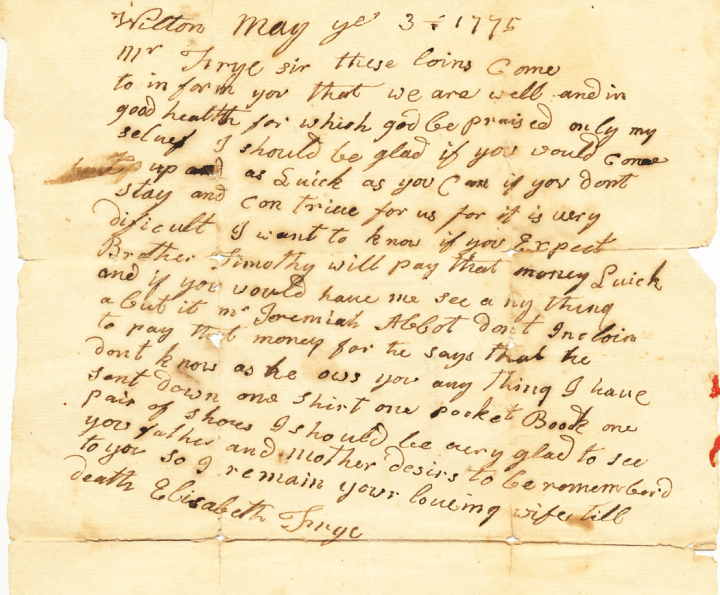
The above letter is one of the five documents. How cool is that? This letter was written two weeks after the alarm, and confirms the militia were being supplied by their families and towns during the early days of the Siege of Boston. The part about whether Isaac owed money to Jeremiah Abbot illustrates the difficulty the wives, who were forced into the role of agent for their husbands. Note: there were no banks in these days–IOUs served as contracts between neighbors.
Enjoy
-CEF

