Behind the Maps: The American Revolution’s GIS Journey

While writing, Trials of War, I got the opportunity of a lifetime to work as an advisor for Florentine Films on The American Revolution. My job was to help them create nearly 100 maps that appear throughout the six-episode series. I really enjoyed that experience, and I thank PBS, Florentine Films, Ken Burns, Sarah Botstein, David Schmidt, Mike Welt, Grace Bartosh, and the many others for the chance to work with them.

My role was mostly the research behind the maps, verifying each place, region, road, path, and so on. I did that using ArcGIS, and I admit it took several thousand hours, most of which were spent before Florentine Films found me.

Once I began working with Florentine Films, I expanded the historical GIS of Colonial America I’d been developing, from the places Isaac Frye traveled during the American Revolution, to include the rest of the North American continent. During the last year or so of production, I created a web map for the graphics team at Phea.TV and the researchers at Florentine Films to check my work and verify their work. I reworked the styling of that map from the high-contrast look that made checking for errors easier to one that hopefully most people will appreciate exploring.

Click here to explore the online map of Colonial North America.

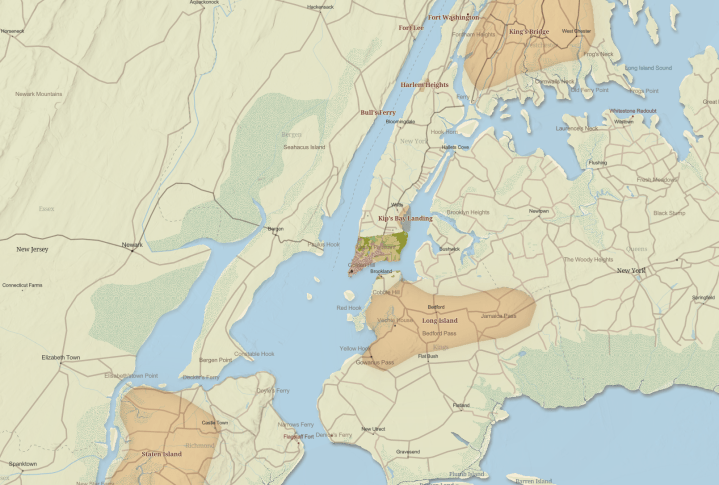
How NYC looked in Colonial North America

This excerpt shows just some of the territory that New York City occupies today.

The map includes a collection of layers that depict where the European colonists lived, but also where the North American Indian tribes lived in 1775 and 1607.

For anyone who is already an ArcGIS user, I’ve shared the web map and all of the layers in the Colonial North America Layers and Maps group in my ArcGIS Online Home Use account. The data, layers, and maps are free to use under a CC BY 4.0 SA license.

You can learn more about how we created the maps in the series by watching the LinkedIn Live stream video, The Maps Behind the American Revolution, where I, Mike Welt, and Grace Bartosh tell the story of how we made them.

-CEF

“The Trials of War” is Available

I am pleased to announce that The Trials of War is available. Normally, when I publish a new book, I share the most interesting aspects of the research in my posts. This time, my research began with family history. Abiel Frye, Isaac’s oldest brother, shows up in a surprising way. Then the challenge of unraveling how Isaac Frye came to be court-martialed late in 1779.

Ten years ago, when I first sketched out the plot for The Trials of War, I had not known Abiel would factor in. Then, a few years later, while reading Daniel Livermore’s journal entries, Abiel Frye is mentioned in the May 23, 1779 entry: “… I passed the evening very agreeably with our own corps of officers, and Mr. Abial Frye. …”

That led to some research under the auspices of, ‘What are the odds?’ First, Abiel Frye is not a common name in Colonial America. Only Isaac’s father, who died in 1757, and Isaac’s oldest brother appeared in any searches I’ve made, which include Ancestry.com and FamilySearch.org. Even with all the time afforded me during the COVID-19 shutdown, it took months to finally work out that the 3rd New Hampshire officers indeed dined with Isaac’s older brother, and I also tracked down the story of how they came to cross paths in north-central New Jersey. Here are some of the items I found:

  • This 1912 entry in the Daughters of the American Revolution’s publication, American Monthly Magazine, page 273, includes many pertinent details about Abiel Frye via a sketch of his father-in-law, Eliab Farnam’s service during the American Revolution:

“(2) Farnam (Varnum) — Fry. — Eliab Farnam is called Varnum in Miner’s History (4668), and a reference made to his regiment (p. 191). He was ensign of the first militia in Preston, Conn., Oct., 1771 ; lieutenant in same company May, 1774; and captain of the 8th Co., or train band in the 24th Conn., Oct. 11, 1775. The 24th was formed in May, 1775, and consisted of men from the town of Westmoreland, now Wilkes-Barre, and vicinity, in Pa. His second child, Joshua, was killed by the Indians in 1779 (Miner, p. 466). Abigail, dau. of Eliab Farnam, m. (1) Eleazer Owens, March 20, 1779, who was killed in the Battle of Minisink, July 2, 1779. A posthumous son, Eleazer Owens, was b. Jan. 1, 1780, and m. Margaret Buck (dau. of Elijah and Margaret (Foster) Buck). Abigail Owens, the widow, m. (2) Abiel Fry (or Frye), ensign and second lieutenant in the French and Indian Wars. He was son of Capt. Abiel, and descendant of John Fry, of Andover, Mass. He went from Andover to Pa. in 1763, and was the schoolmaster of the settlement (the Wallenpaupeck) for several years (see Miner, p. 467). Feb. 2, 1784, he m., in Goshen, Orange Co., N. Y., the widow Owens, as before stated, and lived in Goshen for ten years ; was town treasurer, a member of Solomon’s Lodge (No. 1), Poughkeepsie, Dutchess Co., N. Y (which he joined in 1775), and a member of the Presbyterian Church. In 1794, he and his wife and five children moved to Tioga Co., N. Y., but in 1806, while in Goshen on business, Abiel Fry d. of a fever. Is this service sufficient to entitle his descendants to recognition in the D. A. R.?”

That entry and question gave me my first clue, given the Frye family genealogies I’ve read indicated that Abiel Frye, had died in Goshen, NY, which is just north of the New Jersey border, only a few miles from the route taken by the troops marching from Camp Soldier’s Fortune to Easton, PA. The reference to Miner’s History of Wyoming, pages 464-476, gives more details, particularly regarding the settlement in Lackaway Township. today called Lackawana, Pennsylvania.

  • Another reference, this time in the September 1903 edition of Sons of the American Revolution’s Spirit of ’76 magazine on page 19 (link to PDF of scanned pages), provides the following:

“Two interesting articles on the early history of Masonry appeared in the October 1901, and the April 1902 issues of “The Spirit of ’76’. In neither one of those was any mention of Solomon’s Lodge, No. 1, Poughkeepsie, N.Y. The records of this lodge contain a demit to the effect that one Abiel Fry was raised to the sublime degree of Master Mason on the 14th day of June, in the year of Masonry 5775, and the year of our Lord 1775.

The above Abiel Fry or Frye was born Nov. 8, 1734, in Andover Mass.; was in the Alarm list there, April 29, 1757; at Fort William Henry Aug 10, 17 57, and continued to serve during the French and Indian wars of 1758-59 and ’60. In the year 1763 he went to the then Province of Pennsylvania. In “Miner’s History of Wyoming”, pages 466-67, reference is made of a certain schoolmaster named Fry. In all probability this is the same Abiel Fry. On the 2d of February, 1784, he married Abigail Farnum Owen (widow), in Goshen … In 1794 he with his family removed to Chemung, N.Y., and in 1793 was made an elder in the First Presbyterian Church of Chemung and Newton, now Elmira. …

Further information regarding the Above Abiel Fry or Frye, between 1763 and 1784, especially any information or proof of any service he may have rendered his country or any department, civil or military, is desired. Certain references to him in family history lead to the supposition that he may have been in the Commissary department.”

  • The latter item was attributed as a letter from Mrs. David Gillespie of Lincoln, IL.

Based on the above, I was able to fill in the gaps of Abiel’s history and fully bring him into the story.

Next, I had one rather disturbing fact to figure out. Again, this came from Daniel Livermore’s journal, this time the October 26, 1779 entry: “… and a brigade court martial is called, of which Major Titcomb is President, for the trial of Capt. Isaac Frye, of the third battalion of New-Hampshire forces of which I was a member. The charge brought against Capt. Frye was ungentlemanlike behavior and defrauding the officers of the regiment of public stores. …”

There was a lot to unpack, including the idea that Livermore may have edited his journal after the initial writing, given the clause qualifying that he was a member of the third battalion of the New Hampshire forces. Defrauding the officers, but not the enlisted soldiers, also caught my eye. Two months earlier, Livermore made a remarkable midnight journey, crossing the Great Swamp, riding fifty miles back to Easton and beyond in less than two days. He never explains the reason for his mission, but I found that it occurred the evening after a letter for Brigadier General Enoch Poor, who commanded the New Hampshire Brigade. That letter was from Major Caleb Gibbs, the commander of General Washington’s lifeguard. Gibbs mentions a quantity of liquor captured by Anthony Wayne’s forces at Stony Point. Coincidence? I doubt it. Rum and alcohol of any variety were in scarce supply. You’ll need to read the book to see how this turns out.

-CEF
Battle of Breed’s Hill Patriot Locator Map

Years ago, I decided to figure out where my ancestor, Isaac Frye, who fought in the Battle of Breed’s Hill on June 17, 1775, was positioned on that battlefield. My background as a geographer led me to map the battle using GIS and keep adding details until I succeeded.

One thing I learned is that because I located my ancestor, I could likely locate every American who likely fought, though I would need to do a few things first. These included figuring out who fought or was on the battlefield, then using GIS to place each soldier on the map at the location of their respective regiment or company.

In the spirit of keeping this post short, here is the link to the Battle of Breed’s Hill Patriot Locator Map. Use the search box to enter the surname, and if needed, the first name of any American who fought in the battle.

There are about 200 American soldiers whose names I do not know because no rolls for their companies exist any longer, or they are not in the usual repositories such as the National Archives or their respective state archives. If I’ve omitted your patriot, I would love to add them, but I will need information about their unit and some proof of their service. Contact me via a comment or an email.

CEF

ArcGIS Pro Map Package for Battle of Breed’s Hill

Happy 4th of July! After publishing the List of Americans in the Battle of Breed’s Hill from the Rolls last year, I had intended to also publish the ArcGIS Pro map I used as part of the research to compile the list. Today, I am finally sharing that here today.

Download: Battle of Breeds Hill Troop Locations and Movements.

The above link will open the ArcGIS Online homage page for the map package. In the upper right, click Download, and then in ArcGIS Pro, use the Import tab to add this map to your Pro project.

Included in the Map Package

  • Layers for the initial deployment of troops and artillery at the regiment and, when it was needed, at the company level.
  • Layers for locations of troops and artillery during the initial phase of the battle.
  • Layers for locations of troops and artillery during the final phase of the battle
  • Muster of the names of the Americans who fought (note this is not as current as the spreadsheet in the List of Americans in the Battle of Breed’s Hill from the Rolls.

Requirements

This map package requires using ArcGIS Pro version 2.8 or newer. ArcGIS Pro is available as Part of university site licenses or, like I use it, via the Personal Use Account.

I advise having at least an intermediate or greater level of experience/comfort using ArcGIS Pro to get full value from this map. In particular, skills to query tables within a moderately complex relational data model are needed.

List of Americans in the Battle of Breed’s Hill from the Rolls

This is a roll of who was or likely was in or at the June 17, 1775 battle. It is not exact, complete, or the last word. The early historians Swett, Frothingham, Loring, et al. agreed that there is no basis for compiling an exact list. I completely agree with them, though we can compile useful from all of the available information.

Newly available in April 2026: Interactive map for locating patriot soldiers on the Breed’s Hill battlefield: Battle of Breed’s Hill Patriot Locator. This map is based on recent research aimed at revising and improving the locations of the British units.

I intend this roll as a 21st-century digital convenience. It is for those who wish to get a faster start researching patriot ancestors, town histories, etc.

Beyond appearing in each of the state rolls, there were two criteria for including soldiers in this roll:

  1. There was a “positive” statement of their being in the battle. This included being a casualty, prisoner, losing items, or being specifically listed on a roll as in the battle. There is a “Positives” column in the Company Summary tab reflecting the count of soldiers with a positive statement.
  2. The dates of service include June 17, 1775.  This is not positive proof, but proof of the potential to have taken the field. Typically, this was a roll taken between June 18 and August 2. These rolls gave enlistment dates in April, May, or June, and durations of service. There were a few rolls taken before the battle that established a term of service after accounting for those who marched and served for the April 19, 1775, alarm.  Many men who marched on April 19 went home within a week and did not return to the siege.  It is also worth noting omissions to the state rolls. There were quite a few soldiers who served from late April or early May only until the end of July and were not part of the Continental Army. There are cases where the Aug 1st Massachusetts rolls were not taken or did not survive, and I would assert as many as 250 men were not included in the state rolls or this digital version of them. There were also dozens of soldiers who fought but were from other units that are not recognized as marching. These men were on details or among friends and chose to march with their companies and regiments. There were also men who marched, took the field, and then were sent on duties, or left, and went back to camp. Such men are included as they were on the field at a time when others were in physical and mortal danger. The Company Summary tab has two fields 1B and 1A that indicate Y or N for a roll before the battle (1B) or a roll with service dates after the battle (1A).

Last, on the company summary tab, there are fields for phases and zones. Phases represent the three British offensives during the battle. Zones represent areas of relative conflict. Zone 1 is the accepted main line of battle, including the range of a musket on either side of where that line moved. Zone 2 is the rest of the Charlestown Peninsula, which required an act of bravery in and of itself to march onto via the Charlestown Neck. Zone 3 is the area beyond the Charlestown Neck including Lechmere Point. General Ward sent units to guard against a second landing of the Regulars. Col. Paul Dudley Sargent noted unfavorable winds also prevented this landing. However, these troops took casualties from cannon and grapeshot from the floating gondolas and smaller ships that could make their way deeper into the Back Bay.

If you note some one is missing or wrongly included, please email me at duty_liberty@mail.com, or comment on this blog – I generally can respond within a day or two. Follow this post to be notified of updates, which are listed below.

-CEF

Updates:

3/15/2021: Added Captains Abraham Dodge and Ezra Lunt from Col. Moses Little’s regiment.

3/14/2021: Removed most men from Capt. Abel Wilder’s company of Col. Doolittle’s Regiment – only part of the company was there. Added Capt. John Harnden’s company of Col. Bridge’s regiment. Added several individuals found due to improving the quality of the Massachusetts rolls file. Removed three duplicated soldiers.

3/10/2021: Added several from Connecticut.

3/9/2021: Added Daniel Shay

4/21/2022: Added Henry Farrington and Ichabod Farrington – previously omitted due to garbled OCR in Massachusetts rolls file.

2/29/2024: Learned of Samuel Bradish of Abel Wilder’s Company in Doolittle’s 18th Mass. Regiment. In Bradish’s record, the service dates included the battle and that he was wounded. I was surprised to see these service dates had been omitted from Capt. Wilder’s record. Based on this, I added Bradish and 44 additional soldiers from Wilder’s company. These men were predominantly from Winchendon and Royalston, with a few from Boston and Lunenberg.

Improved text for searching MA Soldiers and Sailors

The scanned text of 17 volumes of Massachusetts Soldiers and Sailors of the Revolutionary War, a Compilation from https:archive.org, was difficult to search through because there were so many errors, including misrepresented names, broken words, and garbled entire pages of text.

After several years of gradual progress, I have completed the work to correct hundreds of thousands of systematic errors in the OCR (optical character recognition) process is complete. Each record is now on one line in the file with no breaks, making it a better basis to determine the composition of companies or regiments at various times, inventory of which towns the soldiers were from, traits of soldiers from rolls that described the men (hair, eyes, height, ethnicity, occupation, etc.; and which men were in specific battles — in the form of a positive claim containing the words like killed, wounded, captured, or lost items or a tacit claim for being in the unit at the time of the battle.

The original “text view” was copied into files for each volume. I processed those files using Python to remove the arbitrary end of lines, thus concatenating the text for each soldier. My goal was to be able to do wildcard searches per soldier such that I could find matches between company commanders and regiment commanders. For instance, searching for “ilder.*Doo” would find men in Capt. Abel Wilder’s company., Col. Ephraim Doolittle’s regt. That syntax is for Notepad ++. I got tired of doing that manually in each of the 17 volumes. This also addresses not having to search across volumes for sound-alike names such as Ayres and Eyres.

This is a large file – STRONGLY RECOMMEND using in Notepad++ or do a bit of programming in Python (DO NOT ATTEMPT IN: NotePad, WordPad, or even MS Word). Both Notepad++ and Python support wildcard and extended character searching, e.g., “\n\r”. Notepad++ is limited to one wildcard, so for complex sequences, Python is the only option (using the regex library and conditional logic to mimic an SQL query with multiple WHERE clauses).

Removing end-of-line characters described above generally worked, but issues with the OCR process resulted in many false interpretations of characters and unintended insertions of new lines. So, I also started replacing some of the safer sequences:

Daxiei to Daniel x4
Daxiel to Daniel x68
Aakon to Aaron x3
Reubex to Reuben x 35
AxLEX to Allen x7
Johx to John x452
JoHx to John x63
Jamks to James x7
AVigglesworth to Wigglesworth x36
Woodbridjje to Woodbridge
Bexoxi to Benoni x5
Bexjamix to Benjamin x98
Williaji to William x70
Joxathax to Jonathan x51
Lejiuel to Lemuel x5

If you are tempted to do similar, please be aware that many seemingly safe find/replace pairs will produce unintended changes Use Find first to locate a large number of prospective changes to be certain of avoiding changing valid information.

Sometimes the OCR process in combination with a poorly printed page created a mess. For instance:

An^TT.w SPr-eant Capt. Joseph Uichards’s co.; enlisted Aug. 11, 1779; ser'”‘^”^^ZZ 3 a”;n^.’detach,nent under Capt. Samuel Fisher at Rhode Island.

Should be:

Allen, Abijah, Sergeant, Capt. Joseph Richards’s co.; enlisted Aug. 11, 1779; service 1 mo. 3 days with detachment under Capt. Samuel Fisher at Rhode Island.

Thus, if you’re looking for specific person, the scanned version on archive.org is your best option.

-CEF

Honor and Valor – Historical Insights

Does your book provide any new contributions to our understanding of history? Most historians and people with degrees in history ask this of me when they learn of the research behind my books. It’s also an excellent weed-out question for those who like to read, whether it’s narrative-history, biography, or historical novels.

In Honor and Valor, I divide the contributions to historical understanding into two categories:  New Inferences from existing documents, and first tellings of these inferences.

First Tellings:

  • 40 Man Scout: In Chapter 6, I assembled the following:
    • A name by name composition of the forty-man scouting party from the rolls of all five of the regiments under Enoch Poor.
    • A plausible route from Louden’s Ferry to where they were ambushed.
    • Plausible reasons for undertaking the scouting mission in the first place.

The route came from military terrain analysis, and the site of the ambush from the Mohawk perspective was far and away the best option given the terrain, giving the Mohawk warriors cover, concealment, high ground, and placing their adversary in likely swampy lowland terrain. Luck was on my side for identifying men in the scouting party.  They left on September 4, 1777, and returned the following day.  Most regiments took their rolls on the fourth and noted the members as “On a Scout” or “On Command.” The total of such references from all five regiments was forty men.  No additional rolls were taken until January 1, 1778, but those rolls confirmed the results. My narrative of the battle combines the terrain analysis with Thomas Anburey’s account from within Burgoyne’s camp and Gavin Watt’s description that provided casualties on the Mohawk side, which implied the possibility of an attack on the caravan itself – in particular, John Deserontyon’s wounding; he was already wounded and I thought it unlikely for him to lead the ambush.

  • Battles of Saratoga from the perspective of being embedded in Isaac Frye’s company: The descriptions of these battles I’ve read are all akin to a bird’s eye view on a military-style walkthrough description. Those are necessary to form a basic understanding. Read enough of them and one can become rather immersed. But, do so with the intention of putting yourself in the shoes of a specific participant, and now your point of view changes radically, narrowing and becoming grounded, literally. What this person saw, heard, and might have done, minute by minute for several hours.  In particular, I am indebted to the work in Don Troiani’s Campaign to Saratoga – 1777: The Turning Point of the Revolutionary War in Paintings, Artifacts, and Historical Narrative. As a compilation of the most recent historical insights on these battles, it proved invaluable context for the specific accounts offered by members of the New Hampshire regiments in their letters and journals. I walked Isaac’s likely path through those battles Saratoga National Historical Park for an entire day to get the perspective of a six-foot-tall captain attempting to make sense of a chaotic battle over uneven terrain and through clouds of smoke from musket- and cannon-fire. Try putting yourself in a regiment commander’s place – I found smoke to be the first enemy you might face when making decisions to commit your men or to avoid losing your men.
  • The Fever at Valley Forge:  In cursory histories of battles, there is an assumption that because a regiment was present, they fought, and that every man in the regiment participated. Very early in my research, I figured Isaac fought in the Battle of Monmouth based on such thinking.  Instead, I learned he was sick. In Chapter 13, after analyzing the monthly rolls, I was able to piece together a far larger and more significant pattern of sickness in May, June, and July at Valley Forge.  I analyzed all rolls from March through September from the five regiments under Enoch Poor (1st, 2nd, and 3rd NH; and 2nd and 4th NY). Isaac’s company was percentage-wise the hardest hit.  There was no way to give a name to the disorder, or even to assume that it was just one disorder. I suspect the men who came back with William Adrian Hawkins carried it into camp, though Hawkins either avoided it or like Henry Dearborn only had a mild case that wasn’t reported in the rolls; Dearborn noted his case in his journal. An additional theory is all the fordings of the Schuylkill River, which must have been chilly, even in May, may have progressively undermined the men’s immune systems.

New Inferences from Known Documents:

  • Recruiting a Company in 1777:  In Chapter 2, I had to set aside my initial assumption that Isaac traveled around to each town. New Hampshire had organized its militia by county and assigned muster masters who knew the composition of their county’s militia and who might be good candidates for the Continental Army.  Major Abiel Abbott is who Isaac would have relied upon to expedite the recruiting of his company.
  • 24 hours in Schaghticoke: In Chapter 5, I got lucky.  After doing my initial research, I had a good narrative. I  was also in contact with Christina Kelly, the Town Historian for Schaghticoke, NY, starting with a 2011 blog on Major Van Veghton, then sharing Joseph Gray’s narrative for what had occurred.  Christina dug in and found a much richer story, and shared Schaghticoke in the American Revolution: A New Perspective on the Death of Major VanVeghten in August of 2018.  I combine these to tell a full version from Isaac’s narrative perspective.
  • Final Siege at Saratoga and the Surrender:  It seems to me this part of the victory at Saratoga is never told in full, and I enjoyed piecing it together.
  • Captain Beal at Fishkill:  This is important for the build-up of circumstances, particularly the lack of pay for the New Hampshire Continentals. For years, an incorrect account of Captain Beal circulated on the Internet and I am happy to report I can no longer find it.
  • Battle of Barren Hill: Also written from the perspective of those on the ground. This is a plausible telling of these events, as they are not as extensively documented. However, it became clear after piecing together the timeline for regiments learning Von Steuben’s new manual of arms that Captain Daniel Livermore, as senior officer, would likely have had command of the 3rd Regiment as Dearborn and Scammell, who were both in camp confirmed their presence in camp in their writings. There are a long series of untold and remarkable instances where junior officers had to assume command of their regiments due to the senior officers being otherwise engaged. I was glad for the opportunity to tell how Livermore and Isaac likely stepped into larger roles in this instance.

CEF


Here’s a great article, following up on the intersection of Joseph Gray’s narrative and the Van Veghton family’s accounts of the New Hampshire Continental troops assisting in the evacuation of Schaghticoke, NY in August of 1777.

I am re-writing that part of Book 2 in Duty in the Cause of Liberty for the third time now.  Hoping that is the proverbial charm.

-CF

How do we accurately know and report what happened in the past? We learned in school that we should consult primary sources- oral histories; diaries; newspaper reporting; birth, death and marriage certificates, etc. – things created by the people who participated in the events. Of course, we know that everyone experiences an event differently, […]

via Schaghticoke in the American Revolution: A New Perspective on the Death of Major VanVeghten — History of the Town of Schaghticoke

Schaghticoke in the American Revolution, Major VanVeghten scalped

Got to love the Internet for providing the basis to connect the threads of history! See my comment proposing the connecting the thread at the end.

schaghticokehistory's avatarHistory of the Town of Schaghticoke

          In the last post, I related a Knickerbocker family legend that the fort near the Mansion was occupied by Hessian soldiers at the time of the battle of Saratoga. Though I doubt very much that that was true, there is no doubt that there were bands of Tories, Indians, and perhaps Hessians and British roaming through the area during the summer of 1777 before the battle of Saratoga. Major Dirck VanVeghten of the  local militia unit, the 14th Albany County, was killed by one band when he came from Saratoga just before the battle to check on his home in Schaghticoke. One source states that VanVeghten came home on “an intelligence gathering mission.” In either event,  he was accompanied only by Solomon Acker, one of  the soldiers in his company of the 14th Albany County Militia.

            The story of Major VanVeghten really illustrates the great variety…

View original post 662 more words

Nathan Weare’s 1777 Ticonderoga Diary was Actually Sullivan’s Expedition in 1779!

As I’ve been writing “Honor and Valor”, book two of Duty in the Cause of Liberty, I have had to get back into research mode. I always look for journals written by the men who were there–these journals have an authenticity historians cannot replicate. In writing about the lead-up to the evacuation of Fort Ticonderoga, I found a reference to the “Diary of Lieut. Nathan Weare Kept at Ticonderoga and During the Retreat, 1777.” Read more