A recent posting on the George Washington’s Mount Vernon site, Committees of Correspondence, got me thinking about how much I’ve depended on the records of such committees for my research. Read more
Iroquois Network has Complete Coverage
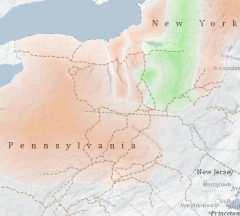
In an earlier post, I described using Geographic Information Systems (GIS) to facilitate my research to trace Isaac Frye’s path through the American Revolutionary War. Occasionally using GIS produced more than just a map; it produced new historical insight. One such instance occurred while researching Sullivan’s Expedition, or as it is sometimes called, the Iroquois Expedition. Read more
Using GIS to Research Isaac Frye
New Letters Uncovered
In The War has Begun, I include transcripts from the two letters my family has preserved. One is from Isaac to his wife, Elizabeth, in 1775, and the other from Elizabeth late in 1776. I spent hours thinking about the story between the lines of these letters, and am grateful my cousin found these in the attic of Isaac’s house in the 1990s.
Fast forward to this past Monday evening. I was having dinner in North Hampton with my uncle and cousin, celebrating getting the book published. My uncle asked to get scans of the two letters so he could share with others in the family. Last night we learned the steamer trunk where our two letters were found also contained five more documents wrapped within non-descript paper!
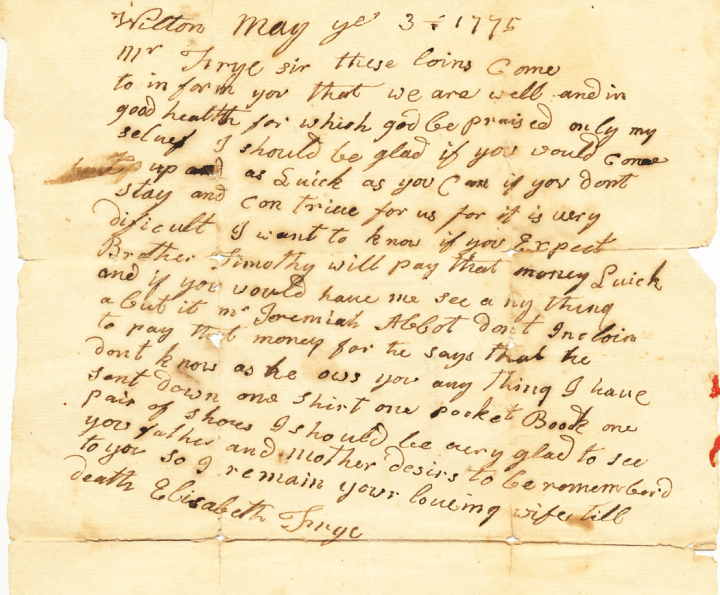
The above letter is one of the five documents. How cool is that? This letter was written two weeks after the alarm, and confirms the militia were being supplied by their families and towns during the early days of the Siege of Boston. The part about whether Isaac owed money to Jeremiah Abbot illustrates the difficulty the wives, who were forced into the role of agent for their husbands. Note: there were no banks in these days–IOUs served as contracts between neighbors.
Enjoy
-CEF

